TGN Desk:
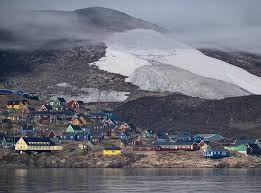
The village of Ittoqqortoormiit in Greenland remains covered in ice for nine months of the year. Visiting this place offers a clear understanding of what life is like at the far northern edge of the world.
In today’s interconnected world, experiencing travel to truly remote places is extremely rare. Even rarer is the opportunity to learn how people live in some of the planet’s most isolated regions.
UK-based photographer Kevin Hall was fortunate to have such an experience, which he described in an article for the BBC.
Ittoqqortoormiit is a small village with a population of about 370 people. The houses are painted in bright, colorful shades. There are no roads in the village. Access is possible only by helicopter, boat in summer, or snowmobile. Alternatively, travelers can fly to Nerlerit Inaat Airport, located about 40 kilometers away. Flights operate twice a week—one from Iceland and one from western Greenland.
There are no nearby towns or villages. The closest city is around 800 kilometers away. The surrounding area is icy and desolate, home to polar bears, musk oxen, and millions of seabirds.
For nine months each year, the sea around Ittoqqortoormiit is frozen. During this time, the indigenous Inuit people travel over the ice using dog sleds and go in search of game. According to Kevin Hall, it takes only about half an hour to walk across the entire village. Facilities include a church, a small travel agency, a police station, a bar, a guesthouse, a heliport, and a small supermarket called Pilersuisoq. This supermarket receives supplies by ship only twice per season.
The village celebrated its 100th anniversary in 2025, but in recent years the population has been declining. Estimates suggest that since 2006, the population has dropped by about 35 percent.
The main reasons are that younger generations are leaving their traditional hunting-based lifestyle in search of new professions or education in cities. In addition, climate change has caused sea ice to form later and melt faster.
At the same time, the United States has repeatedly expressed interest in purchasing Greenland from Denmark. As a result, Ittoqqortoormiit now faces two major challenges: climate change and geopolitical tension.
Kevin Hall wrote that traveling in such extreme cold was not just an adventurous journey, but one of the most challenging experiences of his life. He first flew from Iceland to Nerlerit Inaat Airport and then spent five days traveling over frozen terrain, where temperatures dropped to minus 40 degrees Celsius.
He wrote:
“I traveled by dog sled, slept in tents and small hunters’ huts that had no beds, running water, heating, or other comforts. I crossed 45 kilometers by snowmobile in blizzards with winds reaching 80 kilometers per hour.”
According to Kevin, this was not merely a photography expedition—it was a rare glimpse into how people live in one of the most remote places on Earth and how they struggle to adapt to a rapidly changing world.
Living with Extreme Cold
The trip was arranged by renowned photographer Joshua Holko, who organized two local Inuit guides—Oge Danielsen and Manasse Tuko. Together, they traveled by dog sled from Nerlerit Inaat Airport to Ittoqqortoormiit. Their goal was to photograph the world’s most isolated and awe-inspiring polar landscapes.
Describing the early part of the journey, Kevin wrote that on the first night they camped in small tents near the airport, with temperatures around minus 30 degrees Celsius, dropping steadily. Danielsen and Tuko cut frozen codfish from the ice using a saw, boiled it in melted ice water, and announced that dinner was ready. The fish was tasty, though full of bones. Still, their main concern was what lay ahead.
Kevin said he had never experienced such cold before. As they curled up inside their tents, fierce winds shook the fabric, and the sled dogs barked loudly. He suspected that Arctic foxes or bears might have been passing nearby. As the temperature fell further, his legs began to cramp. He described it as a true initiation into extreme cold.
National Symbol
The next morning, after breakfast, the guides carefully loaded bags, cooler boxes, camera cases, dog food, and supplies onto the sleds. Two people rode on each sled, with a guide in front controlling the dogs. Over the next six days, 12 Greenland sled dogs on each sled pulled loads of more than 450 kilograms, covering up to 25 kilometers per day.
These dogs, known as “Qimmit” in the Inuit language, are large, husky-type dogs believed to have been brought from Siberia to Greenland about a thousand years ago. Today, they are considered a national symbol of Greenland.
One morning, while traveling 10 kilometers west of Ittoqqortoormiit, the team spotted four musk oxen standing on a distant hilltop. Kevin described them as prehistoric-looking animals weighing around 400 kilograms, with short horns, long black-brown hair blowing in the wind, and an appearance that was both intimidating and photogenic.
They approached carefully, as Holko had warned that these Ice Age–like animals can become aggressive if startled. After nearly an hour of photographing them, the musk oxen slowly moved higher into the hills—perhaps aware that in Ittoqqortoormiit they are considered a delicacy.
Hunters’ Life
On the third day, Danielsen told Kevin about a small hut he owned about 25 kilometers away and invited him to stay there for two nights. Kevin agreed immediately, hoping it might offer a chance to see polar bears.
The hut was painted bright blue and contained a small sofa, a chair, a sink, a stove, and a toilet. Although Danielsen earns extra income as a guide, hunting is his true passion, profession, and ancestral tradition. Local law prohibits hunters from selling the meat or skins of hunted animals, and exporting musk ox products is strictly forbidden. The meat may be used only for family food and clothing, just as it has been for generations.
From the hut, the team traveled about 20 kilometers east. After five days of travel, they reached Cape Hope, a small settlement 14 kilometers west of Ittoqqortoormiit, with about 20 old huts, where they spent the night.
The next morning, they spotted a polar bear. Danielsen suddenly shouted, “Polar bear! Polar bear!” The bear stood on the ice about six kilometers away for 20 minutes before slowly walking off.
Kevin had hoped to photograph another type of polar bear known as the “ghost of the Arctic,” whose white fur blends so perfectly into the environment that it is almost invisible. However, he did not encounter one.
Life at the Edge of the World
Kevin noted again that Ittoqqortoormiit can be walked across in about half an hour and contains only basic facilities. The supermarket shelves were mostly empty, and prices were extremely high. He wondered how local people manage to afford necessities when job opportunities are so limited.
In his conclusion, Kevin wrote that seeing polar bear skins hanging outside many homes reminded him of the deep roots of this community. He had come to photograph wildlife, and although he did not see the “ghosts of the Arctic,” he felt no regret.
Instead, he gained something more valuable:
an understanding of how people survive and live their lives at one of the most remote edges of the world.
Courtesy : BBC / Daily Protham Alo